A Mascot Suit's Summer, and Now a Walking Character Robot
Stricter heat rules have made mascot suits harder to run. Disney and South Korean companies are putting character robots to work.
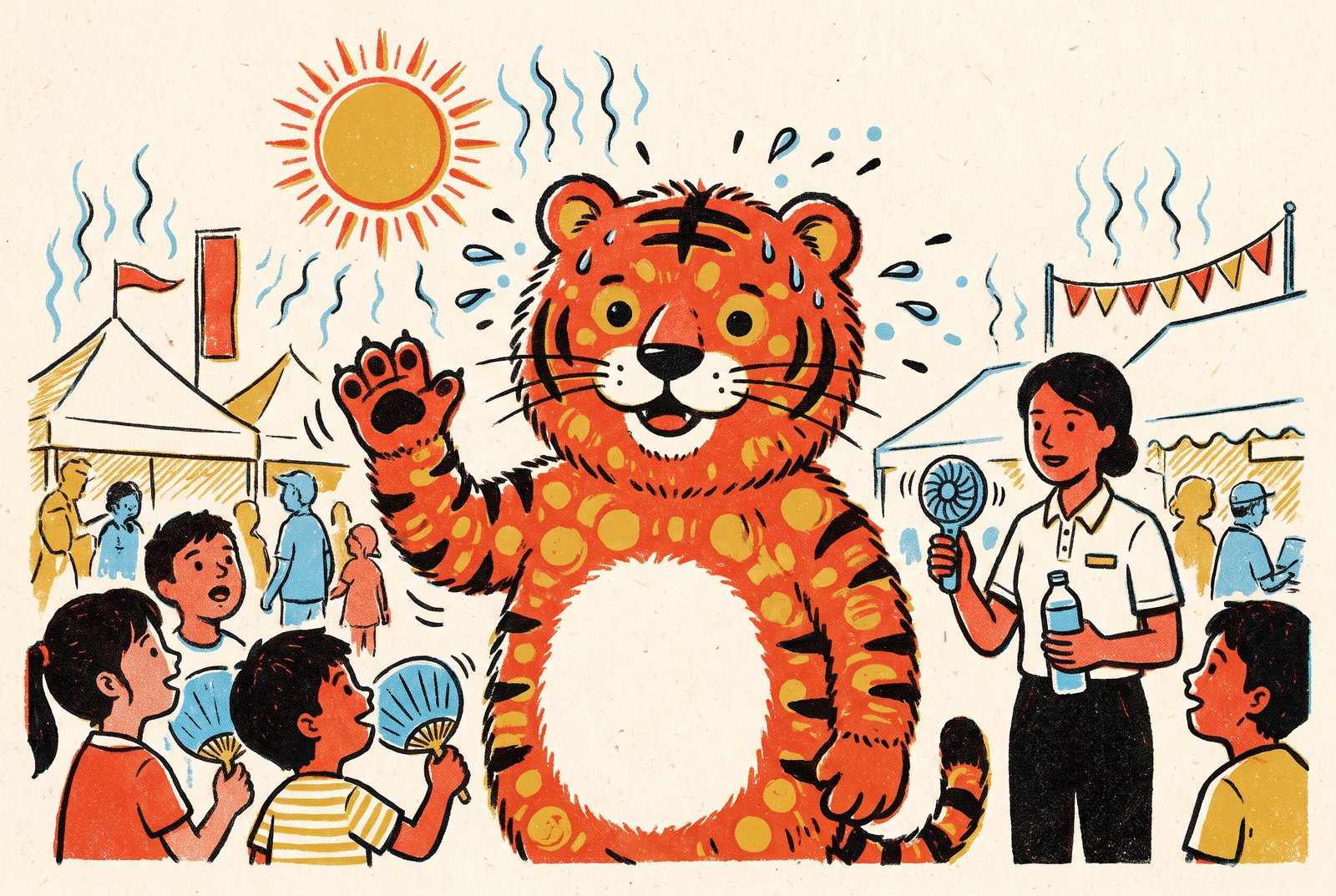
The most common way a mascot meets people is through a costume suit, but it is hot inside a mascot suit.
The heat inside the suit
In July 2018, there were reports that a part-time worker performing in a mascot suit at Lotte World collapsed from heatstroke. In July 2019, at an amusement park in Osaka, Japan, a 28-year-old part-time worker collapsed and died while practicing a dance outdoors in a 16 kg mascot costume.
In 2026, a revision of the Ministry of Employment and Labor's rules on occupational safety and health standards took effect. Where the heat index is 31 degrees Celsius or higher, employers must take steps to reduce heat exposure for work lasting more than two hours. At 33 degrees or higher, workers must rest for more than 20 minutes every two hours. At 35 degrees or higher, the rules recommend stopping outdoor work from 2 p.m. to 5 p.m. A reporter who tried street promotion in a mascot suit said the temperature inside the suit was effectively at heat wave levels.
Enter the character robot
Starting March 29, 2026, Disney introduced a self-walking Olaf robot in the "Frozen" area of Disneyland Paris. It learned its gait through reinforcement learning based on the walk in the animation, and its legs are hidden under a foam skirt. Its voice is recorded, and there is also a mode in which a performer controls it.
In South Korea, a 158 cm Kumdori guide robot appeared in the opening parade of the Daejeon 0 O'Clock Festival in August 2025. Made by robotics company Lastech, it avoids obstacles and talks in Korean and English.
Lud Dynamics, which operates Daily Mascot, is also turning mascots of public bodies and companies into two-legged walking character robots (Ludbot) about 90 cm tall. It held a demonstration with the robot wearing the outer shell of Jongdori, the mascot of Jongno District.
Can robots replace the suit?
Robots are still expensive, and they cannot fully replace the body language and improvisation of a human performer. Still, robots are moving first into places where heat and safety rules make it hard to keep mascot suits running for long.
Sources
- 위키트리 2018년 8월 14일(롯데월드)wikitree.co.kr
- Yahoo News 2019년 7월(히라카타파크)yahoo.com
- 파이낸셜뉴스 2026년 6월 7일(폭염 규정)fnnews.com
- Laughing Place 2026년 3월 16일(올라프 로봇)laughingplace.com
- arXiv 2512.16705(올라프 로봇 논문)arxiv.org
- 산업일보 2025년 11월 8일(꿈돌이 로봇)kidd.co.kr
Daily Mascot Newsroom
See an error in this story? Request a correction
The name, chosen from about 100 fan entries, combines the Korean characters for "spring" and "benefit." The club plans to use the mascot at home games and on merchandise starting next year.